The History of the FLAMES Game — Where Did It Come From?
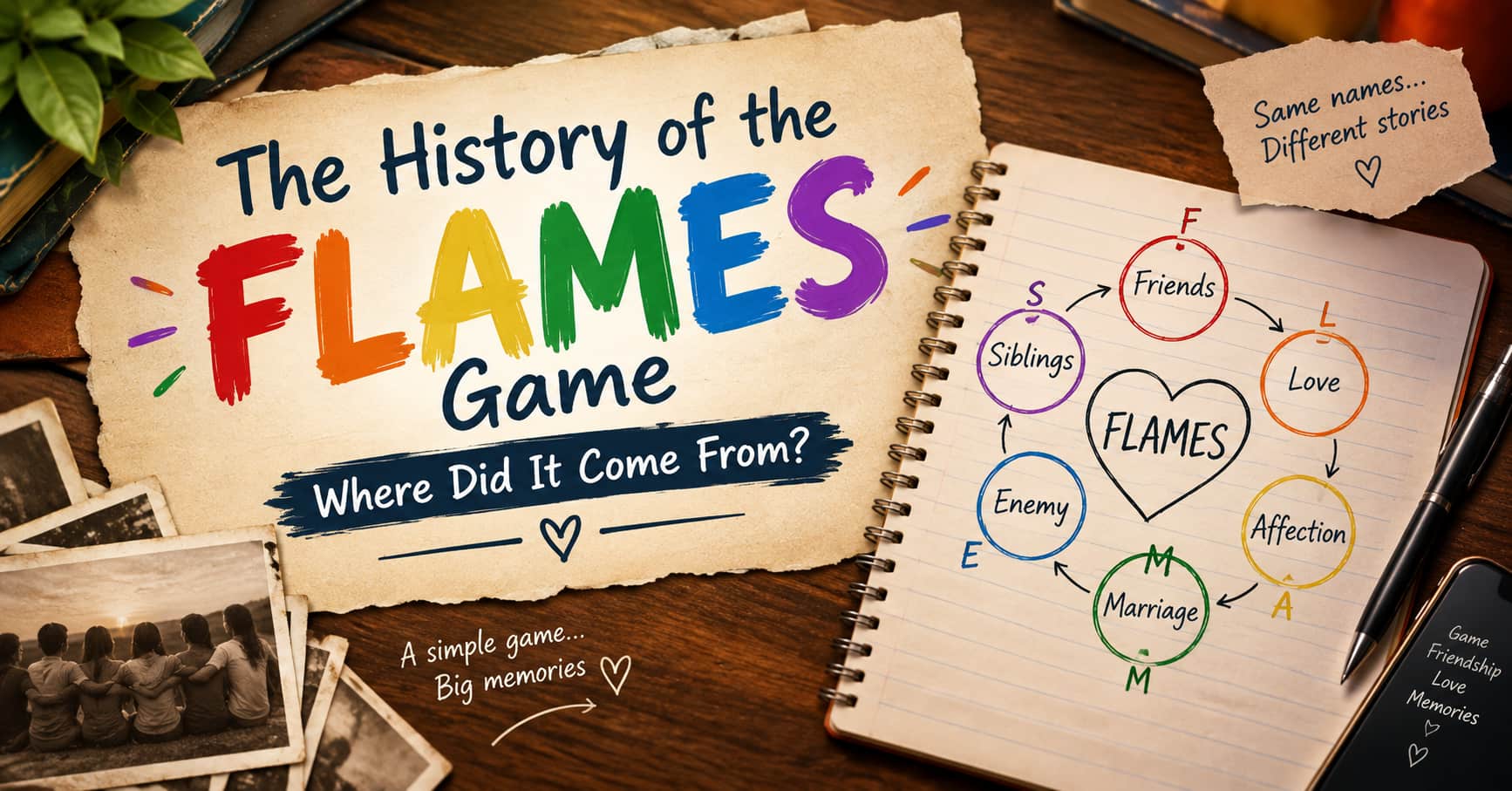
Long before anyone typed two names into an online FLAMES Calculator, the game was played the old-fashioned way — with a pen, paper, and a bit of patience.
A Playground Classic
FLAMES — short for Friends, Lovers, Affectionate, Marriage, Enemies, Siblings — traditionally spread as a schoolyard game. Two people would write out their names, cross out matching letters by hand, count what was left, and count through the letters F-L-A-M-E-S until one remained.
| Letter | Meaning |
|---|---|
| F | Friends |
| L | Lovers |
| A | Affectionate |
| M | Marriage |
| E | Enemies |
| S | Siblings |
Why It Became So Popular
Part of the appeal was how quick and visual it was. Unlike a full percentage-based love calculator, FLAMES gave a single, easy-to-remember word as an answer. It also worked for more than just crushes.
From Paper to Pixels
As online tools became common, FLAMES was one of the first "love games" to be digitized. Today's FLAMES Calculator runs the exact same letter-cancelling, letter-counting process instantly, without needing a pen or paper.
Is FLAMES Still Just for Fun?
Yes, and that hasn't changed. FLAMES has never been a scientifically validated relationship test — it's always been a lighthearted game, whether played on a napkin in the 90s or on a phone today.
How FLAMES Spread Around the World
Like many playground games, FLAMES doesn't have a single documented inventor or publication date — it spread the way folklore usually does, passed from friend to friend and classroom to classroom long before anyone thought to write it down. Regional variations popped up over the decades: some versions use slightly different words for the letters, some groups play with three names instead of two to include a rival or friend, and some cultures blend FLAMES-style letter-cancelling with their own local numerology or fortune-telling traditions. What's stayed consistent across almost every version is the core mechanic — cancel matching letters, count what's left, count through a set of category letters until one remains.
Why a Game With No Official Rules Still Feels Consistent
One interesting thing about FLAMES is that despite having no official publisher, rulebook, or governing body, the core mechanic has stayed remarkably consistent across generations and regions. That's likely because the method is simple enough to remember and teach on the spot — anyone who's played it once can teach a friend in under a minute, which is exactly the kind of game that survives purely through word of mouth. It's a good example of how a simple, repeatable algorithm can become genuinely viral long before the internet existed to help it spread.
FLAMES and the Rise of Online Love Games
FLAMES was part of a broader wave of simple, name-based "love games" that existed in playground culture well before the web — heart-shaped doodles with initials, folded paper fortune tellers (sometimes called "cootie catchers"), and various counting rhymes all served a similar social function: giving friends a low-stakes, slightly silly way to talk about crushes without having to say anything directly. When these games moved online in the early 2000s and 2010s, FLAMES translated especially well because its output — a single word like "Friends" or "Lovers" — is inherently shareable and screenshot-friendly, which matters a lot in an era of social media.
Trying FLAMES Today
The appeal of FLAMES hasn't really changed since its playground days — it's still fast, still visual, and still works just as well with a best friend's name as it does with a crush's. The only real difference is that the counting now happens instantly instead of by hand, and the result is easy to screenshot and send to a group chat instead of being scribbled on the corner of a notebook page.
Curious what your names spell out? Try the FLAMES Calculator or compare it with a percentage-based result on our main Love Calculator.